Data, Policy, and the Future of the K-Pop Industry.
The Music Industry Strategy Center — K-Link Global's research arm — studies the structural challenges shaping the K-Pop ecosystem: data-driven policy design, royalty collection and distribution, performance rights, and AI & copyright. Below is a look at our flagship publication, alongside current research underway.
The Future of the K-Pop Industry.
Strategies for Sustainability in the Data Era
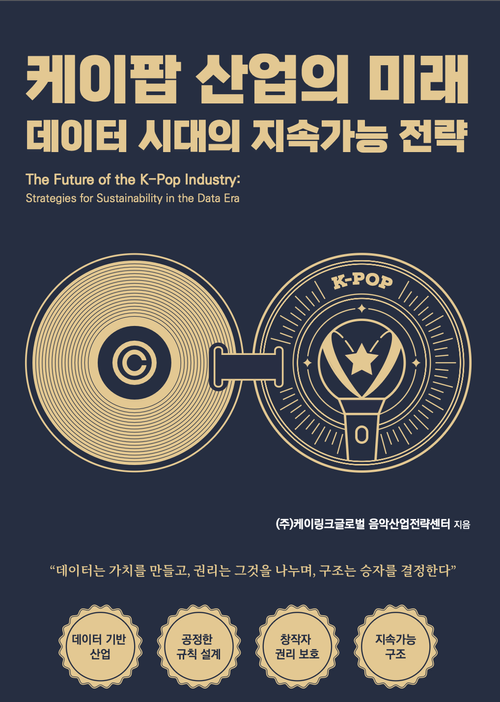
K-Pop has become a defining force in the global music market — but the governance behind it has not always kept pace. Written by K-Link Global's leadership team, this book traces the structural imbalances behind Korea's streaming royalty system, proposes a data-driven copyright simulator to make "invisible money visible," and examines how generative AI, TDM licensing, and Korea's performance-rights framework will shape the next decade of the industry.
Three Parts, Eleven Chapters.
Redesigning the System
The "black box" of Korea's collective management structure, royalty settlements with no underlying data trail, and a proposed data-based copyright simulator to model how money actually flows.
AI-Era Copyright & Legal Exposure
Korea's AI Framework Act, the legality of text-and-data-mining (TDM) for model training, and the unresolved fair-use questions facing generative AI in creative industries.
Global Issues & Policy Response
Korea's "positive list" performance-rights regulation, small-business resistance to royalty collection, and a comparative benchmark against JASRAC, ASCAP/BMI, PRS, STIM, and the U.S. MLC.
In the News.
K-Link Global CEO Sangmoon "Noah" Ock presented "The Future of the K-Pop Industry: Designing Trust for Growth" at a special seminar hosted by Yonsei University's Institute of Public Affairs and Institute for Governmental Studies. The session examined how data and AI are reshaping the global music industry, and outlined strategic priorities for the sustainable growth of Korea's K-Pop industry amid global competition.
Read Coverage on Yonsei University News →Columns by K-Link Global.
Our team publishes ongoing commentary on Korea's music industry policy, expanding on themes from The Future of the K-Pop Industry.
By Brian (Taejin) Um — An examination of Korea's Public Performance Right system, why its "positive list" regulatory structure leaves many commercial spaces outside the scope of royalty collection, and what a data-driven, internationally aligned performance-rights framework could mean for the global economic value of K-Pop. Expands on Chapter 7 of The Future of the K-Pop Industry.
Read on Brunch →By Brian (Taejin) Um — As generative AI increasingly writes melodies, lyrics, and vocals, this piece asks how human creators should be protected — from the question of authorship when AI assists composition, to data-access rights for AI training, to voice-cloning and publicity rights for K-Pop artists. Argues Korea should act as a "rule maker," not a "rule taker," in shaping global AI-music governance. Expands on Chapter 10 of The Future of the K-Pop Industry.
Read on Brunch →What the Strategy Center Is Working On Now.
Beyond our published work, the Music Industry Strategy Center maintains an active research pipeline on the structural issues shaping Korea's music and content sectors.
Broadcast Royalty Structures
A study of royalty and fee structures related to the broadcast use of music, examining how collection and distribution practices align with global standards.
Positive-List Performance Rights Reform
Continued policy analysis on Korea's performance-rights "positive list" regulation, international reciprocity gaps, and pathways to bring the system in line with global norms.
AI & Copyright Policy Tracking
Monitoring global generative-AI licensing deals, TDM case law, and Korea's legislative response — building toward a licensing-based framework for AI training data.
Data Governance for Collective Management
Applying international CMO benchmarks (MLC, JASRAC, PRS, STIM) to Korea's collection and distribution infrastructure, in support of a "Korean-style MLC" concept.
For institutional inquiries about our research capacity or to discuss a potential engagement, please contact us directly.